Random ruminations of an Evolutionary Technologist (a.k.a. Edublogger) who believes that "It's not what you take but what you leave behind..." Fun part of that could put him in good company with the likes of Benjamin Franklin, Eisenhower, JFK, John Lennon and Steven Spielberg. Longer list is here. Serious part is that he also focusses on Technology, Economics and Society.
Saturday, July 19, 2008
CV Tag Cloud
Friday, July 18, 2008
OCM What?
Sunday, July 13, 2008
Forget about fossil fuel...
Which reminds me, whatever happened to Daniel Dingle?
Saturday, July 12, 2008
Wednesday, July 09, 2008
... or worse, be committed to the ward, for things I've been writing about education lately.
Now it's good to be getting some validation from the nixty.com. I don't even know the guys behind it, but what the heck.
I like that bit about Disrupting Education: Flattening the Ivory Tower. It seems to predict that in 6 years, education is going to be radically different. Don't know if I should hold my breath, but it should be worth the wait.
Thanks to Michael Feldstein.
Friday, July 04, 2008
* I could be wrong though.
Tuesday, June 24, 2008
Another Social Network Site? The "About us" tells us the following:
His wife, Nanette de Dios Alcaro, is the President. She has 20 years experience in the deluxe hotel business in Manila and the U.S., having worked with The Peninsula NY, Plaza Athenee NY and Hotel Bel-Air LA as the Director of Sales and Marketing.
They have over 45 combined years of marketing expertise in the U.S., worldwide and online. Together they have created the business and marketing model behind FilipinoVillage.com."
Monday, June 23, 2008
... seriously, let your child "play with fire".
You got to hand it to Gever Tulley.
Tuesday, June 17, 2008
Thus reports Inquirer.net. It goes: "Companies must prepare to accommodate and learn to adapt to a new generation of workers that rely heavily on the Internet, according to a top IBM executive."
More here.
Somehow it seems like schools/universities need to play a major role in this "injunction".
But what if teachers are afraid of technology? 64 million dollar question ...
Sunday, June 08, 2008
I'd like to refrain from taking sides. Nonetheless, some people are getting some good SEO-driven attention. See for yourself in this search result.
Saturday, June 07, 2008
Here's an excerpt from Inquirer.net
"PHUKET, Thailand--Social networks such as Facebook have not only revolutionized the way people communicate over the Web but are also seen as useful to businesses."
IBM's David Barnes tells us more in the video.
Friday, June 06, 2008
aka "How to blog without really trying."
Thursday, June 05, 2008
"In addition to low fuel consumption, the VCM engine also reduces exhaust emissions, helping meet govt Ultra-Low Emissions and 2010 fuel consumption standards, making it eligible for preferential 'Green Tax' treatment. The engine achieves this by combining high-density catalytic converters located directly below each cylinder head for further improved exhaust gas processing at low engine temperatures with better air/fuel ratio control.
VCM continuously analyzes throttle opening, vehicle speed, engine speed, and gearing to determine that the car is cruising, and then idles the intake and exhaust valves of the three cylinders in the rear cylinder bank. With zero valve lift, the cylinders are sealed, and no fuel is injected. Pumping losses are thus reduced by as much as 65% and low fuel consumption is realized.
When operating in 3-cylinder mode, engine vibration is reduced by extrapolating vibration from the change in crankshaft rotation speed and sending the information to the 'active control' engine mount, which compresses/extends an actuator in same-phase, same-period motion to dampen the engine mount. Similarly, a speaker creates an opposite phase sound or 'active noise control', to provide a cancelling effect, for a quieter interior which leaves the driver unaware of changes in cylinder activation."

Just don't know how it feels to the driver when activation/deactivation kicks in. Perhaps I could use a day to test drive a VCM 643-powered Honda? (Hint, hint.)
you could annotate and add links to your YouTube videos.
"So check it out."
Thanks Tris for showing me the "first interactive video on YouTube." (Sorry, embed disabled)
Saturday, May 31, 2008
it's rather ironic that claiming retirement benefits from the Philippine Social Security System(SSS) is anything but social.
Here's a colorful rant from a FIL-AM based in he USA trying to claim his pension benefits:
"I can't understand what really freak they want, lagayNow for what this is worth, I could perhaps hook this fellow up to someone who could be of assistance to him and anyone similarly situated. So, buddy, just shoot me an email at joel.yuvienco[at]gmail.com
ba? or paddrino. These are very simple matters why
they are trying to make it hard. How can they verify
the premiums of my previous companys for my sss
contribution. It will take them forever, maybe some of
them aren't existing anymore and how could they do
that its been 23 or 25 years that's rediculous!
The only company that might be able to give them maybe
the big ones but i am not sure if my name is still in
their files ... "
Thursday, May 22, 2008
aka eSchoolNews showcases Arcademic Skill Builders.
"Arcademic Skill Builders is a nonprofit web site that features online educational games offering a new approach to learning basic math, language arts, vocabulary, and thinking skills."More here.
Thursday, May 15, 2008
Elevator pitch is dead?
[via Javed Alam on his Facebook Status]
Tuesday, May 13, 2008
Thus Google gets more social
Associated Press reports that Google joins effort to make more Web sites more sociable.
"Google hopes its latest social tools will encourage people to
spend even more time online, giving the company more opportunities to
show the advertising that generates most of its profits."
Time to party? Don't ask me but I don't know who'll come home with a headache.
Thursday, May 08, 2008
Can't wait to lay my hands/eyes

Friday, May 02, 2008
Not bad considering that Wired and Techcrunch were rated a superb 10. Click here to see the current field of blogged.com-rated technology blogs.
Thanks Amy Liu.
Wednesday, April 30, 2008
Sunday, April 27, 2008
Voluminous may offer one answer.

[via boingboing.net]
Indeed, it's not the idea, it's what you do with it. Sounds like share the science, make money off the technology?
Tuesday, April 22, 2008
Product:
... you might need the services of a "bio-data" maker.
Wikipedia defines Résumé like so:
"A résumé, also known as a curriculum vitae (CV), American and British English respectively, is a document that contains a summary or listing of relevant job experience and education, usually for the purpose of obtaining an interview when seeking employment. Often the résumé or CV is the first item that a potential employer encounters regarding the job seeker, and therefore a large amount of importance is often ascribed to it."
Place:
Online aka the World Wide Web
Price:
Pricing starts at $68.95 for entry level 0-2 years total work experience. Remember that it's a professional and executive resume writing service.
Promotion:
Resume Maker.
Process:
1. Complete the order form and choose your package.
2. Their team lead will get in contact with you to conduct an in depth one on one interview.
3. Receive your 1st draft.
4. Finalize your resume with the team lead.
Promise:
- An electronic copy of your professionally made resume
- A scannable version of your resume
- A cover letter personalized just for you
- A thank you letter after your first job interview
- Unlimited revisions for 30 days"
Tuesday, April 15, 2008
Obsolete skills and Web 2.0 resumes
In 1993, Seymour Papert wrote a premonitory piece about Knowledge Machines and how "reading will no longer be the unique primary access road to knowledge and learning, and it should therefore no longer be the dominant consideration in the design of School."The argument continues:
"Demoting reading from its privileged position in the school curriculum is only one of many consequences of Knowledge Machines. A child who has grown up with the freedom to explore provided by such machines will not sit quietly through the standard curriculum dished out in most schools today. Already, children are made increasingly restive by the contrast between the slowness of School and the more exciting pace they experience in videogames and television. But the restiveness is only a pale precursor to what will come when they can freely enter virtual realities of animals in Africa or wars in ancient Greece."Makes one wonder what skill set companies would be looking for in the 21st century workplace.
Which brings me to this question: Does that mean it makes better sense to learn via YouTube videos?
Tuesday, April 08, 2008
Mashable reports that:
"When big brands decide something is hot, they will move in and attempt to copy it. Sometimes they actually succeed at their goals, and sometimes…well, let’s just say that results are less than spectacular."
Thanks to Mon Duremdes.
Friday, April 04, 2008
Christy Pettey of Gartner reports:
"Based on extensive discussions and experiences with clients, Gartner has identified five major challenges that organizations face when pursuing social software applications as well as advice to help businesses respond to them:
1 -- Delivering Business Value
2 -- Overcoming Cultural Barriers
3 -- Ensuring Privacy
4 -- Governing Participant Behaviors
5 -- Managing Personal and Professional Time
"The severity of these five challenges will vary significantly from one organization to the next, as does their impact on decisions concerning whether, when and how to proceed with social software," Mr. Bradley said. "There are no absolutes, for each potential social application organization must balance the business benefits over the risks of overcoming these challenges."
[via Reuters]
It's more about people than about technology. Does it get any clearer than that?
Monday, March 31, 2008
Sunday, March 30, 2008
Ustream channel of the presentation:
Wednesday, March 26, 2008
aka how do students in De La Salle-Canlubang discover, disclose, connect and co-create learning?
Figure 1: people@dlscanlubang.org

Discover
Figure 2 below demonstrates how the technology more commonly known as Real Simple Syndication (RSS) gives the user the ability to be on top things of interest thereby offering the latest updates in a personalized fashion.
Disclose
Now by filling in suitable fields in a user’s profile, the owner indicates which attributes best describe him or her to the rest of the community. Some systems give to the user the flexibility of disclosing as much or as little, depending on the suitable level of comfort.
Connecting is something that Friendster, one of the pioneers of Social Network Sites in the early decade of the century, has widely popularized. The ability to invite friends online and get invitations confirmed in a two-way friendship loop gave rise to the practice of “Friending”.
Figure 4: Friends
Co-create
Through what is commonly called tagging, Social Network Sites confer to the users the ability to put some loose categorization of learning objects. The image below shows what is called a tag cloud. It’s an aggregation of ‘popular’ labels used on learning artifacts and the system works to highlight the ‘relative importance’ of the items according to font size.
Figure 5: Tags and Folksonomies
The implication of all these resonates with David Warlick (2007): "students stop being mirrors, and instead become amplifiers. Their job is not merely to reflect what they encounter, but to add value to it. Content and skills are no longer the end product, but they become raw materials, with which students learn to work and play and share. Information is captured by the learner, processed, added to, remixed, and then shared back, to be captured by another learner/teacher and reprocessed."
Tuesday, March 25, 2008
Then perhaps you can do e-business. Here's one step. (You need to be logged in.)
But don't ask me about payment mechanisms, I'm still trying to figure that one out.
Thanks to Manny Pacquiao.
An aside: Seems like html coding is becoming an obsolete skill.
Tuesday, March 18, 2008
aka some valuable lessons from Ross Mayfield.
Sounds good. Resonates with "Getting ready for the Friendster Generation."
[via Larry Cannell]
Thursday, March 13, 2008
Bernhard Warner doesn't think so. He actually marvels at the purposive creativity and coding skills of his students despite the broad disruption that Social Network Sites bring to the school environment.
Makes some sense. After all, learning also happens outside of the school setting.
Tuesday, March 11, 2008
Friday, March 07, 2008
Just my take on Steve Hargadon's recent post.
The printing press is about n; the Internet is about n+ 2^n + n^2.
I like that part which goes: “The Answer to Information Overload Is to Produce More Information.”
[via Jeff VanDrimmelen]
Sunday, March 02, 2008
I've been writing about Web 2.0 for close to 4 years now. Then I realized I've not really described it enough to give an ordinary Website reader a good sense of a typical look and feel of a Web 2.0 site. Good thing someone has done that for me in 12 ways. Slayerment puts it like a prescription on how to "Web2fy" a site:
"1. Replace esomething.com with MYsomething.com
Your web site is not web 2.0 if it has some lame "e" in front of it. We all know your web site is electronic! Let's make it personal with a friendly "my" :).
2. Increase 10px font to at least 12-16px font
Nobody likes squinting their eyes, and no it doesn't look good. Get rid of the small text and replace it with some easy reading text for us productive people.
3. Change categories to tags
Why would somebody want to read your site if it's categorized into specific sections? Your content should be dynamically tagged so everyone can keep track of which is more and less important. Get a tag cloud!
4. Change your news section to a blog
People want to know what's going on with your company besides just formal news. Write something thats cool, funny, stupid, whatever! 1/2 the battle is keeping the audience entertained.
5. Change email a friend to RSS subscriptions
When was the last time you emailed a friend? Have you ever used it? Me neither. Get rid of that worthless feature and get people subscribing to your site via RSS or even...
6. Change bookmark this to social network this
With sites like del.icio.us and Digg you should not be having people bookmarking your site only for themselves to see it. Get your site out there in front of everyone with social bookmarking and networking!
7. Change user account to user profile
Nobody wants a boring user page with just their username and email (Yes, I'm talking to you Amazon). They want a full blown personal page that tracks their whole life and tells the world about how great they are. Get your users involved!
8. Change crappy hard-coded HTML to Semantic HTML with CSS
Your design is cool and all but how do you update it? How do you change it? How does it allow for new content to be added (which is the most important part!)? Get rid of your angst ridden layout and get some semantic HTML styled by CSS in there that is super light and better for everyone - please!
9. It's visitors not HITS!
Once again, this is not the 80's and we don't care about your hits! All that matters is the visitors (Yes, short for unique visitors) and the conversions. Get some Google Analytics on there and stop with the hits talk already.
10. Add comments
People want to contribute and share. Let them! It's better for your users and for your search engines.
11. Change esite.com?id=5235&sort=desc&useless=this &one%20more=still%20useless TO.. mysite.com/meaningful-title
Need I say more?
12. Change custom built site to open source CMS
Come to think about it, just get rid of your whole site and download Drupal or Wordpress and start rocking some free theme. After all, people really don't care what your site looks like that much. They would much rather visit to a terrible looking site with compelling content than a beautiful site with pitiful content. Do it right!"
So if you're wondering what site could benefit from those steps, perhaps the Asian Business Directory.
Tuesday, February 26, 2008
Monday, February 25, 2008
The intersection happens at edutagger.com. Imagine getting "brownie points" for sharing relevant links. Click on the image below to find out more.

Now how do you monetize brownie points?
Sunday, February 24, 2008
Check this out:
Thanks to Nik Peachey."CuePrompter.com - The Online Teleprompter
Free teleprompter/autocue service
CuePrompter is a free teleprompter/autocue service. Your browser works like a teleprompter -no extra software needed. (Go to their site) whenever you need teleprompter services."
Some possible uses come to mind:
- Basic Reading Classes
- Political Speeches
- Valedictory Addresses
- Karaoke Sessions, anyone?
Thursday, February 21, 2008
This assumes the user is a blogger.
- Post a blog entry ideally with just one outgoing link (i.e. to the site being optimized for Google search engine.
- Use the word or phrase being promoted as keyword/s (also known as "anchor text"), i.e. that the target searcher is expected to type in the search box
Post a blog with a link to www.slb.ph and the words "tama na" as text anchor.
Click on "tama na" then on this text to to see what I mean.
Pardon my bias towards Social Media but yes it's doable.
Wednesday, February 20, 2008
Good thing there is a report by the De La Salle Philippines Media Bureau:
"A German educator discussed principles on Shared Governance and University Leadership to Lasallian educators in a forum held last 16 February at the DLSP Multipurpose Hall, 20th Floor Br. Andrew Gonzalez FSC Hall.Even if there is a shared governance, leadership still plays a big role in educational management, Fremerey said. He emphasized that “leaders (the educators themselves) have to respond to expectations of the community, if they want to be accepted as leaders.”
Prof. Michael Fremerey, director of Institute for Socio-cultural Affairs Studies at Kassel University in Germany, emphasized that “shared governance” means the active participation of stakeholders in a university through their collaboration on projects and activities. But he clarified that administrators must identify stakeholders who will play a role in a certain project. For instance, students and faculty may participate in revising or designing a curriculum.
Fremerey, who is also expert in organizational development, said that a university must be transparent in terms of providing access on basic information to the stakeholders.
In terms of accountability, he emphasized that a university should focus on quality and relevance of education, which he considered as areas of challenges that educational institutions face today. “We have to admit that these challenges have not been born and created in the university itself. The call for more quality and more relevant (education) has come from public, economy, and political systems,” he said.Moreover, Fremerey said that an educator should underscore the dynamic balancing of polarities: between change and stability, system and individuals, as well as self-organization (creativity) and intervention (caring)."
Tuesday, February 19, 2008
... because they seem to leave a bad aftertaste.
Anyway, I just thought I'd quote the following:
"Lazy citizens who do not expect much of themselves are the "playgrounds" for corrupt government officials ... " (click the link to see the original context)
Sauce for the goose?
Friday, February 15, 2008
Thursday, February 14, 2008
Tuesday, February 12, 2008
I don't think the IT Department is going to like this.
Sunday, February 03, 2008
For those vaguely aware how large China is, David Feng blogging from Beijing offers some figures.
First off, orders of magnitude jump from 630,000 to 210 million Netizens between 1997 and 2007.
That's like 200,000 more Netizens a day. And 2/3 of that are into Web 2.0 More here.
Saturday, February 02, 2008
Thursday, January 31, 2008
Here's an excerpt:
"The growing use of Web 2.0 and social networking— combined with collective intelligence and mass amateurization—is gradually but inexorably changing the practice of scholarship."
More from Altilab2005 - Distance Education Blog here.
Tuesday, January 29, 2008
Saturday, January 26, 2008
Chris Riedel reports on Chris Dede's, (Timothy E. Wirth professor in Learning Technologies at Harvard's Graduate School of Education) talk at the FETC 2008*. In particular, Riedel notes that:
More here."This evolution (of education) has created a gap between what (Dede) termed 'Classic learning and knowing' and 'Web 2.0 learning and knowing.' According to Dede, many students feel that what they learn is irrelevant to their 21st-century lives. They also feel that they have powerful ways of learning within their lives that are not respected in the classroom. 'Thinking is now distributed,' he said, 'across minds, tools and media, groups of people, and space and time.' It is important, he shared, for people to be fluent in new technologies and literacies because more and more jobs are disappearing that require classical knowledge. "
Perhaps it's just me but the resonance of the message is welcome news.
*Florida Educational Technology Conference
Thursday, January 24, 2008
"The old notion you have to attract, develop, and retain the best and brightest inside your corporate boundaries is becoming null. With costs of collaboration falling precipitously, companies can increasingly source ideas, innovations, and uniquely qualified minds from a vast global pool of talent.The end result is that the corporation may be going through the biggest change in its short history. Now this is beginning to affect education, government and even the nature of the democratic process."
Sounds more like outsourcing doesn't it? But then again, that could be a tricky oversimplification.
[via Loic Le Meur]
Sunday, January 20, 2008
That doesn't mean that Social Networking is passe, right? More here.
Friday, January 18, 2008
"The question is no longer about whether YouTube and FaceBook are suitable media for your in-house training materials and interactive simulations, but rather what's holding you back?"
Read more.
And we're not even talking about Wikis, say to "teach" Economics.
Monday, January 14, 2008
Just parking ideas that could have serious implications for education reform.
Ken Caroll shows the "options" in his blog post here.
Echo Chamber Anyone?
Saturday, January 12, 2008
Steven D. Levitt of Freakonomics fame says:
More here. Then I tested the name Gloria. Go ahead. Make your conclusions."It let’s you type in the first letters of a name and see in a flash the rise and fall of such names by decade. The visuals are amazing."
Friday, January 11, 2008
Science and the City shares a podcast featuring the Chairman of illycaffe S.p.A. discussing the chemistry and technology behind great tasting coffee. [via Cory Doctorow]
Click on the image below to listen to the mp3 file.

Now for the art of drinking coffee, here's how they do it in Italy.
Sunday, January 06, 2008
Seems to be a necessary implication in Paul Lamb's blog entry.
He describes the likely trend:
The following could be a suitable tagline:- Mososo: Simple. Smart. Social."At the end of the day, and likely by the end of the year, I bet you an iPhone we will be seeing alot more mobile social networking. The technology and services are getting better and more easy to use. Most importantly, as the shift to everything mobile and local contintues (sic), and as we become more comfortable with our smart devices doing the connecting for us, mobile social networking is likely to boom."
Friday, January 04, 2008
Seems like the connect (to objects) part of 2d2c still stands.
Saturday, December 29, 2007
Thursday, December 27, 2007
... compiled by Larry Ferlazzo.
[via Michael Arrington]
Have an abundant New Year world!
Monday, December 24, 2007
Peace and goodwill, in spite of ... perhaps because of ...

[A take away from Steve Kayser's wish in 2006]
Happy Christmas World!
Wednesday, December 19, 2007
From what reads like a press release via money.cnn.com:
"IBM (NYSE: IBM) today announced the availability of IBM Atlas for Lotus Connections, a corporate social networking visualization and analysis tool. IBM Atlas for Lotus Connections is designed to help organizations maximize their investment in social software by answering questions such as who the key experts are on a given topic, how they are connected, and whom a user's contacts know that they do not."
"The Net component of Atlas provides a visual indication of the important hubs among topic experts and informal groups that have developed while working on similar projects."
" Reach, the social software dashboard feature in Atlas, helps users navigate the up to six degrees of separation that divide them from a colleague." "The Find component of Atlas builds upon core Lotus Connections expertise capabilities by taking searches beyond the corporate directory to include results based on social data such as reporting structures, blogs and communities."
... and the choices are broader now.

More via Cory Doctorow here.
Tuesday, December 18, 2007
damien describes it thus:
At once simple and complex. It's War and Peace, rolled into one? Your suggestions are welcome."(It) simultaneously validates and rubbishes the claims of Andrew Keen: that the web is in the hands of idiots who are systematically destroying 'the truth'."
Warning: It's a 2-hour movie.
BTW you might need to listen to the this song while/after watching the movie.
Some more intriguing points, especially in the educational context here.
Sunday, December 16, 2007
Image below shows My Profile page.
Thursday, December 13, 2007
Josh Bernoff and Charlene Li of Forrester.com share a simple prescription for deploying Social Technologies.
The image below summarizes the key elements of what they call the POST method.

More details here.
Try AniBOOM Shapeshifters.
Here's one by Ryan Norloch:
[via Mike Abundo]
Tuesday, December 11, 2007
So who are really being left behind?
Sunday, December 09, 2007
Saturday, December 08, 2007
Here's a quote from the article:
"Demographics have always been an imperfect method to match the right message to the right user, but we have relied on them so long that we overlook the fact that many basic ad strategies were designed to compensate for their inefficiency. Flights, disruptive media and frequency all make up for the fact that a lot of money is talking to the wrong people."The implication seems to point to the "unpopularity" of push (n) vs. pull (2n + n2) marketing. The table (from Dion Hinchcliffe) below could perhaps help clarify the options:

David Pollard puts it in richer context. At the core, it seems to be more about trust than about knowledge. More here.
Thursday, December 06, 2007

Tuesday, December 04, 2007
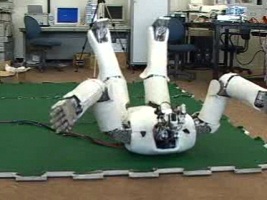
Let's start with robotics.

[Image via Boingboing.net]
"Description:This course provides an overview of robot mechanisms, dynamics, and intelligent controls. Topics include planar and spatial kinematics, and motion planning; mechanism design for manipulators and mobile robots, multi-rigid-body dynamics, 3D graphic simulation; control design, actuators, and sensors; wireless networking, task modeling, human-machine interface, and embedded software. Features descriptions and videos of the two main student projects: building a robot capable of searching for land mines, and building a robot capable of rescuing trapped or injured people after a natural disaster." More here.
Monday, December 03, 2007
| | 19th Century | 20th Century | 21st Century |
| Teaching style | Lecture | Lecture | P2P collaboration |
| Curriculum | Books, blackboard | Textbooks | Community-generated content |
| Location | One-room schoolhouse | Classrooms | Anywhere |
| Interaction | Q&A | Labs | Self-directed exploration, teamwork |
| Objective | Survival | Employment | Lifelong learning skills |
| Tools | Blackboard | Labs | Personal devices |
| Result | “Book learning” | Memorized facts and information | Adaptation, growth |
Source: P. Clint Rogers; Stephen W. Liddle; Peter Chan; Aaron Doxey and Brady Isom.
Web 2.0 Learning platform: Harnessing collective intelligence.
Turkish Online Journal of Distance Education, Volume 8, Number 3, 2007
[URL] via [carsten ullrich]
"Remember....most of the jobs we are preparing our students for don't even exist yet." (BrenniesBytes, August, 2006)
More here.
Saturday, December 01, 2007
That seems to be the starting point of the discussion on how Web 2.0 can enhance professional credibility. More of the linkedin-sponsored Q&A forum here.